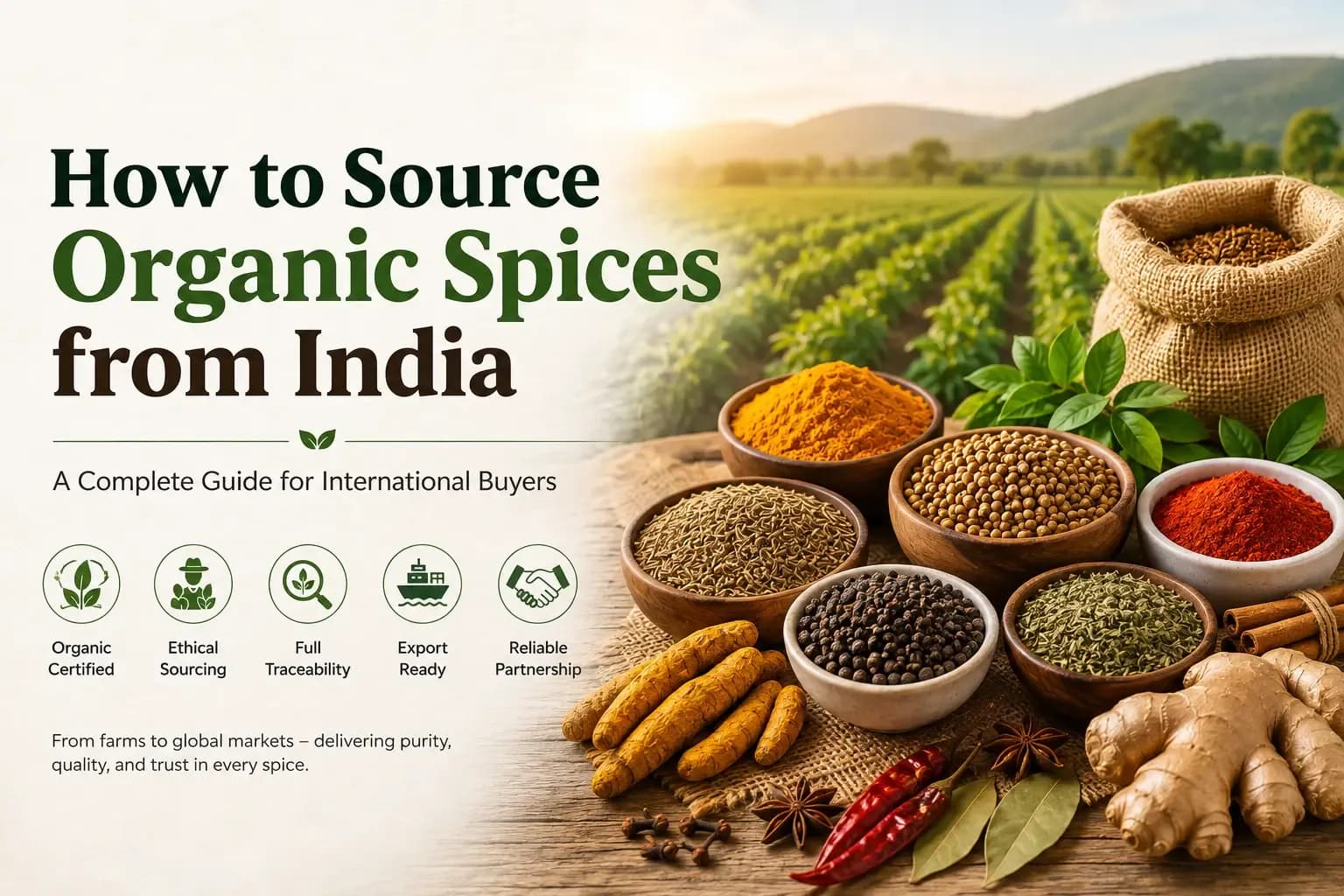
India has long been one of the world's important sources of spices, with products such as turmeric, cumin, coriander, ginger, black pepper, cardamom, and fenugreek reaching markets across the globe. For international buyers, sourcing organic spices from India can provide access to diverse crops, established agricultural expertise, and experienced processing and export capabilities.
However, choosing the right supplier involves more than comparing prices. Buyers need to evaluate certification, traceability, farming practices, processing standards, quality control, packaging, documentation, and supply reliability.
1. Understand Your Organic Spice Requirements
Before approaching suppliers, clearly define what you need.
Consider:
- Spice or herb required
- Whole, ground, or processed format
- Organic certification required
- Origin requirements
- Grade and quality specifications
- Moisture and cleanliness requirements
- Packaging format
- Required quantity
- Target market
- Delivery schedule
- Required export documentation
For example, an importer looking for organic turmeric powder may have different specifications from a food manufacturer purchasing bulk organic cumin seeds.
A detailed product specification helps suppliers provide accurate quotations and samples.
2. Look for a Certified Organic Supplier
Organic certification should be one of the first things you verify.
Ask potential suppliers for:
- Current organic certification
- Certification scope
- Product or crop coverage
- Certification validity
- Processing-unit certification, where applicable
- Relevant transaction or export documentation
Do not assume that a product described as "natural" or "chemical-free" is automatically certified organic. Buyers should verify the actual certification and whether it covers the product and supply chain they intend to purchase.
3. Check Farm-Level Traceability
Traceability is especially important when sourcing organic products.
A reliable supply chain should allow the buyer to understand where the raw material originates and how it moves through the supply chain.
A typical traceability process may include:
Farmer → Farm → Collection → Processing → Quality Control → Packaging → Export
For larger organic supply chains, an Internal Control System (ICS) can help coordinate farmer groups, maintain records, support inspections, and strengthen traceability.
4. Evaluate the Farming Network
The quality of the final product begins at the farm.
Ask suppliers about:
- Farmer network
- Crop-growing regions
- Farming practices
- Farmer training
- Crop monitoring
- Harvest practices
- Soil and farm management
- Record keeping
- Traceability systems
A supplier with a structured farmer network can provide greater visibility into the origin and consistency of agricultural raw materials.
5. Review Processing and Quality Control
After harvest, spices need to be properly cleaned, processed, stored, and packed.
Ask about the supplier's:
- Cleaning process
- Sorting and grading
- Grinding facilities
- Foreign-material control
- Storage conditions
- Batch identification
- Laboratory testing
- Quality inspection procedures
For ground spices, processing controls are particularly important because particle size, colour, moisture, microbiological quality, and other specifications can affect the finished product.
6. Request Samples Before Placing a Bulk Order
Never rely only on photographs or product descriptions.
Request representative samples and evaluate them against your specifications.
Depending on the product, you may assess:
- Appearance
- Aroma
- Colour
- Taste
- Particle size
- Moisture
- Cleanliness
- Packaging
- Laboratory parameters
For larger commercial orders, buyers may also arrange independent laboratory testing or inspection according to their market requirements.
7. Check Export Capabilities
A good domestic supplier is not necessarily an experienced export supplier.
Ask whether the company regularly handles international shipments and can support:
- Export documentation
- Commercial invoices
- Packing lists
- Certificates of origin
- Organic documentation
- Phytosanitary documentation where applicable
- Product specifications
- Certificates of analysis
- Shipping documentation
Requirements vary depending on the destination country and product, so documentation should be confirmed before shipment.
8. Discuss Packaging Requirements
Organic spices may be supplied in different formats depending on the buyer's requirements.
Common options include:
- Bulk bags
- Food-grade sacks
- Cartons
- Retail-ready packaging
- Private-label packaging
- Custom packaging
For B2B buyers, packaging should be selected according to product protection, transportation requirements, destination-market regulations, and intended use.
9. Consider Private Label Options
If you are building your own food brand, working with an experienced private-label supplier can simplify the process.
A private-label partner may support:
Product sourcing → Processing → Quality Control → Packaging → Labelling → Export
Before choosing a partner, confirm their capabilities for your required product range, packaging specifications, certifications, minimum order quantities, and target market.
10. Compare Suppliers Beyond Price
Price is important, but it should not be the only selection criterion.
Consider a supplier across several areas:
Factor
What to Check
- Certification
- Valid and relevant organic certification
- Traceability
- Farm-to-batch tracking
- Quality
- Specifications and testing
- Processing
- Cleaning, grading and processing capabilities
- Capacity
- Ability to fulfil required volumes
- Consistency
- Reliable quality across batches
- Documentation
- Export and compliance support
- Packaging
- Bulk, retail or private label
- Lead Time
- Production and shipment timelines
- Communication
- Responsiveness and transparency
The cheapest quotation may not provide the lowest overall procurement cost if quality problems, inconsistent supply, documentation issues, or shipment delays occur.
11. Build a Long-Term Supplier Relationship
For recurring imports, supplier relationships can be more valuable than one-time transactions.
Regular communication can help both sides plan:
- Crop availability
- Harvest periods
- Forecast quantities
- Production schedules
- Packaging requirements
- Quality specifications
- Shipment timelines
Long-term planning can also make it easier to maintain consistency across multiple orders.
A Practical Checklist for International Buyers
Before finalizing an organic spice supplier in India, ask:
- Is the supplier appropriately certified?
- Can the supplier demonstrate product traceability?
- Where are the spices sourced?
- How are farmers and farms managed?
- What quality-control procedures are followed?
- Can product samples be provided?
- What laboratory testing is available?
- What are the minimum order quantities?
- Can the supplier provide required export documentation?
- What packaging options are available?
- Can the supplier support private-label requirements?
- What are the production and shipping lead times?
Why India Can Be a Strategic Sourcing Market
India offers international buyers access to a broad range of spices and herbs, diverse agricultural regions, established processing capabilities, and an experienced export ecosystem.
The key is to choose a supplier that can connect agricultural sourcing, traceability, quality control, processing, packaging, and export into one reliable supply chain.
Source Organic Spices from India with RK Group
For international buyers, RK Group combines agricultural sourcing with structured supply-chain and quality-control processes to support the movement of Indian agricultural products from farm to processing and ultimately to global markets.
Through its farming network, traceability systems, processing capabilities, and export-focused operations, RK Group works with buyers looking for dependable sourcing solutions across spices, herbs, and related food products.
Looking for an organic spice sourcing partner in India?
Contact RK Group to discuss your product requirements, specifications, volume, and export market.